Hallux Rigidus – Cheilectomy Surgery
Cheilectomy is a surgical procedure performed to relieve pain and restore movement in the big toe joint by removing bone spurs or overgrowth that limit motion and cause discomfort.
Hallux Rigidus is a type of Degenerative Arthritis that affects the Metatarsophalangeal (MTP) joint at the base of the big toe. This progressive condition leads to stiffness, reduced range of motion, and pain often worsening over time and contributing to restricted motion and footwear discomfort.
Early stages of Hallux Rigidus can often be managed conservatively with, footwear modifications, pain relief medications or targeted exercises to maintain joint mobility and strength.
- Conservative treatments fail to relieve symptoms
- There is still healthy cartilage and joint integrity
- The joint structures (ligaments, fat pads, etc.) remain functional
- A small incision made over the top of the big toe joint.
- Removal of excess bone (osteophytes) and any tissue impinging joint motion.
- Closure of the incision with sutures or stitches.
The goal is to relieve pain, improve joint movement and allow for more comfortable ambulation.
Hallux Valgus Surgery – (Bunion Surgery)
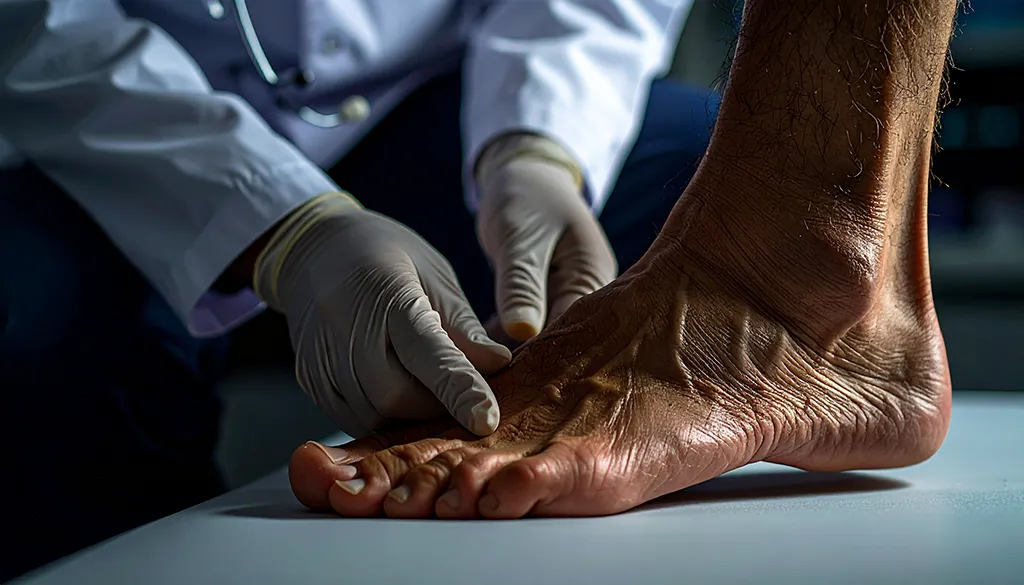
A bunion (also known as Hallux Valgus) is a bony deformity that develops at the base of the big toe, where it joins the foot. Bunions often cause pain and swelling around the joint, which can worsen with walking or standing for prolonged periods.
In addition to discomfort, the deformity can make it difficult to find properly fitting footwear. Bunions are more common in women than in men, and while poor-fitting shoes are a major contributing factor, genetics may also predispose individuals to bunion formation.
Under normal circumstances, the big toe sits in a straight, forward-facing position. Over time, due to pressure or structural changes in the foot, the big toe may begin to drift toward the second toe. This shift forces the bones in the toe and forefoot to angle outward toward the edge of the foot. The resulting misalignment leads to inflammation and new bony growth, which together form the visible bump or deformity we call a bunion.
- Pain becomes severe.
- Symptoms do not improve with non-surgical treatments such as footwear modification, orthotics, or pain relief.
- The deformity is progressively worsening.
- The bunion affects mobility or quality of life.
There are several types of bunion surgery, and the appropriate procedure depends on many factors which your surgeon will evaluate and take into consideration.
Hallux Valgus – Fusion Surgery (Arthrodesis)
Fusion surgery, also known as Arthrodesis, is a surgical procedure that may be used to treat severe or recurrent bunions (Hallux Valgus), particularly when previous procedures have failed to provide lasting relief.
- Severe deformity of the big toe joint.
- Chronic pain and stiffness unresponsive to conservative treatment.
- Recurrence of a bunion after previous surgery (e.g., Scarf osteotomy).
- Presence of arthritis within the joint.
- An incision is made on the top of the foot, extending from the big toe toward the mid-foot.
- The damaged cartilage is removed from the joint surfaces.
- The big toe joint is realigned and then fused in place using screws, plates, or wires.
- Once fused, the joint becomes permanently stiff, eliminating any motion at the joint.
The advantages of Fusion surgery are effective long-term pain relief, the correction of severe deformity and the prevention of recurrence of the bunion.
However, the disadvantages of Fusion include permanent loss of motion at the big toe joint, the alteration of gait or biomechanics, which may affect other parts of the foot or leg in the long run.
Following surgery pain is expected, but can typically be managed with prescribed pain relief medications. Patients are usually required to wear a surgical boot or post-operative shoe for approximately 6 weeks to allow the fusion to heal properly.